The Composed AI Stack: Why Purpose-Built Models Like Jev Matter
A framework and technical benchmark on moving from monolithic LLM-based architecture to composed AI pipelines for enterprise triage and decision-making.
Executive Summary
For the past three years, enterprise AI roadmaps have been dominated by a single objective: standardizing on a frontier foundation model. Whether choosing OpenAI, Google, or Anthropic, organizations attempted to route every prompt, customer query, internal classification, and triage pipeline through the same general-purpose generative engine.
In high-volume production, this monolithic approach breaks down along three operational dimensions:
- Economic Disconnect: Paying autoregressive token fees to make simple categorical decisions (such as “is this urgent or routine?”) inflates inference costs by an order of magnitude.
- Latency Bloat: Generative token decoding forces user-facing workflows to wait between 600 milliseconds and several seconds, creating friction in synchronous web services and customer routing queues.
- Output Fragility & Calibration Failure: General-purpose LLMs generate natural language prose that must be parsed downstream. When forced to assign sentiment ratings or operational tags, they suffer from binary over-polarization, frequently confusing mild customer dissatisfaction with catastrophic escalations.
The Strategic Principle: Task-Specific Intelligence
The next generation of enterprise AI architecture is defined by deliberate composition rather than single-model consolidation. Instead of asking which large model can do everything, enterprise architects must determine what specific kind of intelligence each discrete step in an operational pipeline actually requires.
| Pipeline Task | Required Intelligence | Optimal Building Block | Typical Latency | Cost Profile |
|---|---|---|---|---|
| Fact & Context Retrieval | Exact tabular lookup | Deterministic CRM / Database | < 5 ms | Negligible |
| High-Volume Pre-filtering | Pattern matching on known text | Classical ML (TF-IDF, linear) | < 1 ms | Microscopic |
| Semantic Triage & Classification | Bounded probability distribution | System 1 Classification Model (e.g., Jev) | 200–300 ms | Fixed, low per-call |
| Historical Risk Scoring | Multi-variate tabular scoring | Gradient Boosted Trees (XGBoost) | < 10 ms | In-process compute |
| Complex Text Synthesis & Empathy | Open-ended natural language | Frontier Generative LLM (Gemini/GPT-4o) | 1,000–4,000 ms | High token-based |
| Consequential Decision Making | Organizational accountability | Human Operator | Minutes / Hours | Human operational |
By composing these components, enterprises can reduce token expenditure by 70% to 90%, cut median triage latency to under 300 milliseconds, and reserve expensive human and generative resources exclusively for the high-stakes interactions that warrant them.
Part I: The Architecture Dilemma in Production
Let’s take an example of an e-commerce platform with hundreds of thousands of merchants and customers, your support queue is where architecture meets operational reality. Every single morning, thousands of inbound tickets arrive. Human review for every message is impossible. Volume is too high, SLAs are tight, and labor costs would erode operating margins.
Historically, organizations adopted one of two extremes.
The First Extreme: Brittle Heuristics
The early standard was keyword-based routing. If an inbound email contained “suspended,” it triggered an automated appeal template. If it contained “refund,” it routed to accounting.
While practically free and instantaneous, keyword logic is completely blind to context. It treats a six-year, top-tier merchant with two million yen in stranded inventory exactly the same as an unverified account created yesterday. It cannot detect urgency, emotional distress, or implied business risk. High-value accounts fall through the cracks, escalations multiply, and churn compounds.
The Second Extreme: The Monolithic LLM Trap
When generative LLMs emerged, teams swung to the opposite extreme. Every inbound ticket was passed to a frontier model instructed to read the text and output a JSON routing object.
Comprehension improved instantly. The model understood colloquial phrasing and nuanced complaints. But the operational profile became unsustainable. At tens of thousands of queries a day, passing routine address updates and standard tracking requests through a frontier model creates sluggish pipelines and mounting cloud expenses. Furthermore, generative models are prone to prompt drift and produce uncalibrated probabilities, requiring defensive regex parsers to turn conversational prose back into operational code.
Part II: The Composed Stack in Practice
To make this architecture concrete, consider an inbound seller escalation on a major marketplace:
“My account was suspended and I have two million yen in inventory stuck in the warehouse. I have been selling here for six years. This needs to be resolved today.”
A keyword system fires a generic form. A monolithic LLM spends three seconds generating an expensive response. A composed architecture distributes the work across specialized layers:
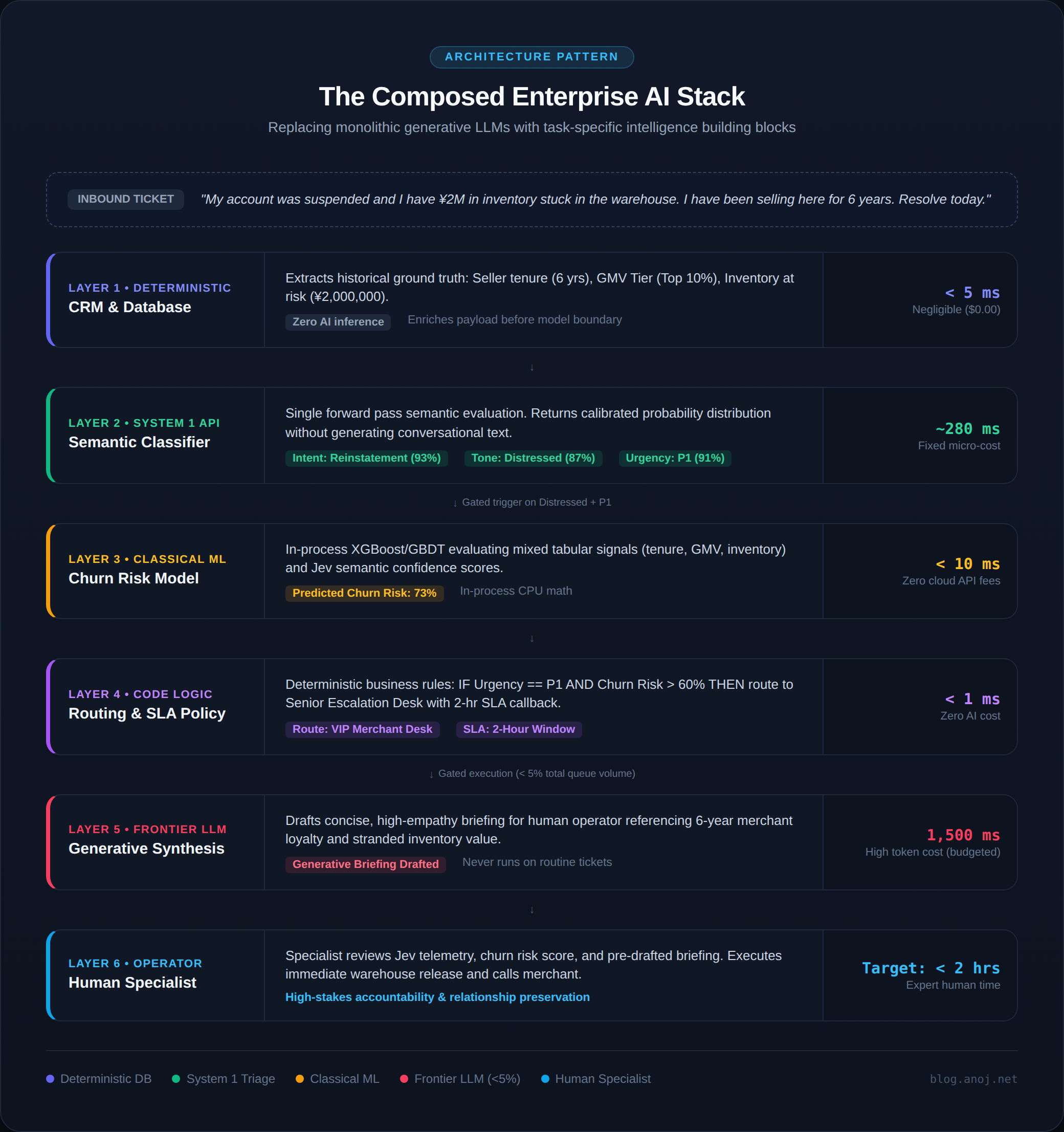
Inbound Support Ticket
         │
         ▼
[ Layer 1: CRM & Database Retrieval ]
  • Attaches seller tenure (6 yrs), GMV tier (Top 10%), inventory value (¥2M)
  • Deterministic database query (0ms AI inference cost)
         │
         ▼
[ Layer 2: Fast Semantic Classifier (System 1 decision model like TypeSafe Jev) ]
  • Intent: Account Reinstatement (93% confidence)
  • Tone: Distressed (87% confidence)
  • Urgency: P1 (91% confidence)
  • Sub-300ms latency, deterministic typed JSON
         │
         ▼
[ Layer 3: Conditional Churn Model (Classical ML / XGBoost) ]
  • Gated execution: triggers only on Distressed + P1 tickets
  • Evaluates tenure and stranded inventory to compute churn probability (73%)
         │
         ▼
[ Layer 4: Explicit Routing Logic (Deterministic Code) ]
  • Rule: Urgency == P1 AND Churn Risk > 60%
  • Action: Route to Senior Merchant Escalation Desk, 2-hour callback SLA
         │
         ▼
[ Layer 5: Frontier Generative LLM ]
  • Triggers ONLY for high-stakes escalations (<5% of total queue volume)
  • Drafts personalized briefing referencing 6-year history and inventory status
         │
         ▼
[ Layer 6: Human Specialist ]
  • Reviews telemetry, churn risk score, and pre-drafted briefing
  • Makes final call: executes instant inventory release or calls merchant directly
In this pipeline:
- Zero AI cost is incurred on basic facts. The CRM pulls historical context deterministically.
- A system 1 general purpose classification model like Jev handles semantic evaluation in a single forward pass. In 280 milliseconds, it classifies intent, distress, and urgency without generating an unnecessary conversational response.
- Expensive models are gated. The churn model runs only when system 1 model flags high distress. The generative LLM runs only on the 5% of cases that warrant customized correspondence.
- Human judgment is concentrated where it matters. The specialist does not spend time reading routine tickets; they spend their day resolving critical merchant relationships with complete situational awareness.
Part III: Practitioner Deep Dive & Benchmark Analysis
To validate the capabilities of purpose-built System 1 models outside marketing claims, I evaluated TypeSafe Jev (version 1.13.0) against Google’s Gemini 3.8 Flash, local open-source encoders, and classical baselines on native Japanese e-commerce feedback from the Amazon Multilingual dataset.
Japanese customer feedback is an exceptional testbed for evaluation: criticism is frequently polite, dissatisfaction is often implied rather than stated bluntly, and minor functional disappointment must be distinguished from catastrophic failure.
1. Sentiment & Ordinal Star Calibration
We tested 100 balanced reviews across all five star ratings (20 reviews each from 1 to 5 stars). The models were tasked with predicting exact reviewer star ratings strictly from the review text.
| Model / Approach | Architecture / Hosting | Exact Star Accuracy | Within ±1 Star | MAE (Stars) | Median Latency (p50) | Tail Latency (p95) |
|---|---|---|---|---|---|---|
| TypeSafe Jev (Choice) | Cloud Decision API | 66.0% | 94.0% | 0.43 | 281 ms | 324 ms |
| TypeSafe Jev (Score) | Cloud Decision API | 56.0% | 94.0% | 0.52 | 281 ms | 324 ms |
| Gemini 3.8 Flash (Low) | Cloud Generative LLM | 56.0% | 93.0% | 0.53 | 615 ms | 7,574 ms |
| Classical ML (TF-IDF + LogReg) | In-Process CPU | 43.0% | 81.0% | 0.88 | 1 ms | 1 ms |
| Laya Multilingual (322M) | Self-Hosted CPU | 33.0% | 74.0% | 1.05 | 2,186 ms | 3,243 ms |
The Binary Over-Polarization Failure Mode
When evaluated purely on binary sentiment (positive 4–5 stars vs. negative 1–2 stars), both Jev and Gemini Flash performed exceptionally well, scoring between 96% and 98%.
The divergence occurred in ordinal calibration. Gemini Flash exhibited severe binary over-polarization: it classified 50% of mild, 2-star reviews as 1-star catastrophic outrage. Autoregressive prompts tend to collapse intermediate nuance into extremes. Jev, by contrast, operates as a discriminant classifier returning raw logits, maintaining calibrated boundaries between adjacent categories. It correctly identified 17 of the 20 2-star reviews.
In production triage, misclassifying mild dissatisfaction as a critical emergency causes support queue thrashing and misallocates high-tier agents.
2. Multi-Class Probability vs. Forced Categorical Strings
In production feedback, customer issues rarely belong to a single bucket. Consider this Japanese review for an audio cable:
“とにかく安いですね。長いケーブルがこの値段ですから。ただ、ケーブルが太いので取り回しがおっくうです。”
(Very cheap for this length. However, the cable is thick so managing it is cumbersome.)
When an engineer prompts a generative LLM with a rigid JSON schema, the model must artificially pick one category (cost vs. usability) or output complex conversational text that requires brittle secondary parsing.
A dedicated System 1 classification model returns calibrated probability distributions across all classes simultaneously:
- Cost / Value: 52%
- Usability / UX: 44%
- Defect / Quality: 4%
This distribution allows downstream services to write clean, deterministic business rules: if primary confidence exceeds 50% and secondary confidence exceeds 30%, notify both the merchandising and quality assurance teams.
3. The Enterprise Sizing Dilemma: Edge CPU vs. Hosted Infrastructure
For infrastructure teams, hosting classification engines internally is appealing, but current open-source models present real operational tradeoffs:
- The Edge Encoder Deficit (Laya 322M): Running a 300M parameter ModernBERT model on commodity CPU instances is cost-effective, but our evaluation showed that small encoders lack the capacity for complex multilingual nuances. Laya scored only 33% exact accuracy and misclassified 62% of reviews as hardware defects due to strong negative prior bias.
- The Datacenter Sizing Barrier: Open-weights decision engines scaled up to multi-billion parameter footprints can achieve state-of-the-art accuracy, but serving large models requires dedicated enterprise GPU infrastructure. For standard IT departments without dedicated cluster operations, running dedicated GPU clusters around the clock solely for triage is economically impractical.
- The Managed Decision API Tradeoff: Hosted System 1 APIs deliver multi-billion parameter accuracy with deterministic sub-300ms response times and zero cluster maintenance. However, they require sending customer data outside the corporate network, which introduces compliance questions in privacy-regulated markets.
Part IV: Operational Root Cause Discovery
Beyond evaluating model latency and accuracy, running Jev and Gemini Flash across operational categories uncovered valuable structural feedback. The two models agreed on 77% of all classifications without few-shot examples, establishing strong consensus on what actually drives customer behavior:
Sentiment vs. Category Distribution (Consensus across 100 Reviews)
┌──────────────────────────────────────┬─────────────┬─────────────┬─────────────┐
│ Category                             │ 1★–2★ (Bad) │  3★ (Mixed) │ 4★–5★ (Good)│
├──────────────────────────────────────┼─────────────┼─────────────┼─────────────┤
│ 初期不良・品質不具合 (Quality Defects)   │     20      │      5      │      3      │
│ 機能効果・体験 (Performance/Experience) │     13      │     10      │     25      │
│ 操作性・説明書 (Usability & Manuals)    │      3      │      3      │      6      │
│ コスパ・価格納得感 (Cost & Value)        │      1      │      1      │      6      │
│ 配送・梱包・誤送 (Shipping & Logistics)  │      3      │      1      │      0      │
└──────────────────────────────────────┴─────────────┴─────────────┴─────────────┘
The data revealed two operational realities:
- What Drives Churn (1★ & 2★ Reviews): 50% to 57% of all negative feedback was caused strictly by out-of-the-box hardware failures (defective batteries, failure to turn on, broken fittings). Mismatches between advertised and perceived performance accounted for 32.5%, while shipping and logistics errors represented only 7.5%.
- What Drives Delight (4★ & 5★ Reviews): 62% to 65% of high ratings were driven by functional efficacy (pores visibly cleaner, excellent flavor, superior audio). Price-to-performance value accounted for only 15% of positive reviews.
For product and marketplace leaders, this confirms that promotional discounts rarely build customer advocacy. Retention is won or lost on core product reliability and defect prevention.
Part V: Two Years in Stealth vs. The Open-Weight Acceleration
TypeSafe reportedly developed Jev in stealth over two years, focusing entirely on fast, deterministic semantic judgments rather than open-ended dialogue.
What is remarkable today is how quickly alternative open-weight models are catching up. Community benchmarks like Benchmark Heaven’s JevBench, which evaluates over 50 Jev-class decision systems across 534 discrete test decisions, show open architectures (such as SemIf on Qwen 3.5, djev, and Winnow) already achieving competitive scores between 70 and 73, right behind Jev 1.13.0 at 74.4.
Given the enterprise demand for fast, low-cost classification, I predict frontier labs will launch dedicated classification and decision endpoints specifically tailored for production product pipelines in the near future.
Whether Jev itself remains the market leader a year from now is an open question. The rapid emergence of competitive open alternatives and potential frontier offerings may commoditize any single proprietary API. But the architectural principle it crystallized is permanent: production enterprise systems cannot run entirely on monolithic generative models.
Part VI: The Ground-Truth Paradox: When Does Classical ML (XGBoost) Beat Foundation Models?
This raises an essential question that every experienced engineering and data team eventually asks: if our enterprise already possesses high-volume, human-reviewed internal data for our workflow, why should we call an external decision model at all? Why not simply train an XGBoost classifier internally?
The answer is that you often should. When you have thousands of historical tickets, dispute records, or content items that have already been audited by human specialists, classical gradient boosted decision trees (GBDTs) like XGBoost and LightGBM remain exceptionally powerful. They run in-process inside your microservices in single-digit milliseconds, require zero external API calls, cost nothing in marginal compute, and do not suffer from prompt drift or third-party API deprecations.
More importantly, real enterprise workflows are rarely composed of text alone. A true escalation decision is inherently multi-modal across tabular and unstructured signals: seller tenure, trailing GMV, dispute history, customer credit tier, and stranded inventory value. GBDTs natively digest these tabular columns alongside text features (such as token n-grams or dense text embeddings) far more naturally than any text-only foundation model.
The Lifecycle Shift: Cold-Start vs. The Steady-State Flywheel
The right way to evaluate classical ML versus System 1 foundation models is not as an either/or choice, but as an evolutionary lifecycle:
- Day 0 (Cold Start & Policy Agility): You launch a brand new marketplace category, expand into a new geographic market like Japan, or issue a revised return policy. You have zero historical labeled samples. You cannot wait six months for annotators to label data. This is where zero-shot System 1 decision models shine: you define your taxonomy in code, deploy immediately, and achieve high-quality semantic triage on day one.
- Day 180 (The Operational Flywheel): As human specialists review and resolve incoming escalations, their actions generate verified, domain-specific ground truth. Once that dataset crosses critical mass (typically 5,000 to 20,000 audited samples), the rational architectural move is to train a dedicated, internal XGBoost model.
- The Hybrid Architecture: You do not have to discard System 1 models entirely in steady state. A highly effective enterprise pattern is to use a fast System 1 model as a feature extractor. The model reads unstructured text and outputs dense probability scores (e.g., distress probability, urgency score). Those calibrated scores are then fed as input features into an internal XGBoost model alongside customer metadata and financial variables.
How to Create Meaningful Ground-Truth Evals
If you have ground-truth data and want to evaluate whether to build an internal ML classifier or use a System 1 API, standard academic machine learning metrics can be deeply misleading. Here is how rigorous enterprise evaluation should actually be structured:
- Temporal Splits, Not Random Splits: Never evaluate using random cross-validation. Real business distributions drift constantly due to seasonal demand, product shifts, and changing customer expectations. Train your baseline on data from months 1 through 9, and test strictly on months 10 through 12. If a model cannot survive temporal drift, it will fail in production.
- Establish the Human Noise Ceiling: Before demanding that an ML model or foundation model achieve 95% accuracy, measure how often two experienced human operators agree on the exact same ticket. In complex support or risk operations, inter-annotator agreement rarely exceeds 80% to 85%. If the human agreement ceiling is 82%, holding an automated model to 95% simply means you are training it to overfit to historical noise.
- Asymmetric Cost Matrices: Stalls vs. Leaks: In standard academic F1 metrics, every classification error counts equally. In enterprise operations, errors are radically asymmetric. As platform teams like Archestra observed when benchmarking decision models on real agent tool calls, classification failures fall into two very different operational buckets:
- False Positives (Stalls & Alarms): Misclassifying a safe or benign event as dangerous or urgent. This causes an automated agent to stall, or needlessly routes a routine inquiry to an expensive specialist.
- False Negatives (Silent Failures & Leaks): Misclassifying an existential merchant escalation or security violation as benign. This quietly passes a critical failure through automated filters, risking catastrophic account churn or sensitive data leakage. A model that achieves 92% macro accuracy by trading away false negatives is an operational disaster. Evals must evaluate models against a weighted financial and SLA loss matrix tailored to that specific workflow.
- Calibrated Confidence and Option-Order Sensitivity: A useful eval does not simply ask if the top predicted label is correct. It evaluates whether the model’s confidence is calibrated and stable across prompts. If an XGBoost model or System 1 engine outputs 70% confidence, does it fail exactly 30% of the time? Furthermore, multi-class evaluations often reveal subtle prompt fragilities: permuting the order of options in a 3-way rubric can shift edge probabilities by 10% to 15%. Well-calibrated confidence and order-permutation testing allow you to define clear operational buffers: high-confidence predictions (>85%) route automatically, while ambiguous predictions drop into human review queues.
Part VII: Practitioner Implementation Notes & Caveats
When incorporating System 1 decision models into your production topology, keep three practical realities in mind:
- Classical ML Remains the Ingress Defense: For ultra-high-throughput ingress layers processing tens of thousands of raw requests per second, simple classical models running in 1 millisecond on CPU remain the correct first line of defense. Do not incur network round-trips to any cloud API where simple local CPU math suffices.
- Taxonomy Quality Governs Model Quality: A purpose-built decision engine will not rescue a vague or overlapping taxonomy. If category definitions overlap (such as blurry boundaries between “usability” and “performance”), the model will return evenly split probabilities. Rigorous label hygiene and clear boundary definitions are prerequisites for deterministic routing.
- Beware Opaque References and Bare IDs: A semantic classifier cannot judge what it cannot read. If your ingress pipeline passes payloads with bare database hashes or opaque identifiers without context enrichment (such as passing
offer_id: "4a2d16..."without the underlying offer details), the model is forced to guess based solely on tool names or schema titles. High-accuracy triage requires feeding human-readable semantic state into the evaluation payload.
The Strategic Path Forward
The early era of enterprise AI was marked by consolidation: deploying large general-purpose models across every layer of the business. That approach was natural during initial exploration, but it is unsustainable in production.
Building resilient, cost-effective AI systems requires matching each discrete pipeline task with its appropriate building block:
- Deterministic software for facts, business rules, and SLA tracking.
- System 1 classification models for high-volume semantic triage, cold-start classification, and guardrails.
- Classical predictive ML (XGBoost / LightGBM) for steady-state tabular scoring, churn prediction, and high-volume internal classification over audited ground truth.
- Frontier generative LLMs reserved for high-touch synthesis, complex reasoning, and customer interaction.
- Human operators where organizational responsibility and empathy are mandatory.
Production excellence does not come from finding one model that can do everything. It comes from architecting a system that knows exactly when a massive model is unnecessary.